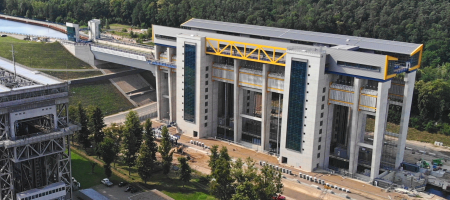
With a total investment of around 300 million euros, the new Niederfinow ship lift is a key structure for the Federal Waterways and Shipping Administration (WSV). To ensure the highly complex plant technology was commissioned flawlessly and on schedule, the Berlin Waterways Construction Office (WNA Berlin) relied on virtual commissioning for the new Niederfinow ship lift. Find out how WinMOD, as a digital twin, minimised functional risks and ensured software quality for this major project from the ground up.
At a glance (TL;DR)
The new Niederfinow ship lift requires the highest safety standards and the processing of approximately 6,000 I/O signals. A physical commissioning process carried the risk of massive time and cost overruns due to the late detection of faults on site. Virtual commissioning using WinMOD created a fully functional digital twin for the Niederfinow ship lift, which emulates the actual behaviour of the system in real time. This enabled the entire control software to be successfully tested in advance, resulting in significantly shorter factory acceptance tests and a risk-free training environment for staff.
High risks and enormous complexity involved in the physical commissioning process
The physical commissioning of a real-world facility can only take place once its construction has been fully completed. By this stage, the hardware has already been installed. If unforeseen faults at the new Niederfinow ship lift had only become apparent at this late stage on the actual facility, this would inevitably have led to considerable additional work and costs. In particular, rectification work or the replacement of individual plant components in a project of this scale involves an immense amount of construction work and time.
Thousands of signals and the highest safety standards
The Niederfinow ship lift replacement project is extremely challenging from both a technological and functional perspective. The trough is driven by four pinions and fixed rack-and-pinion systems, whilst the trough is secured by four rotary bolts that move in tandem with the nut-jaw columns. A mechanical and an electronic synchronisation system safeguard the four heavy-duty trough drives. All these components – including various gates and auxiliary systems – are controlled via a central safety PLC and 25 decentralised system PLCs.
In addition, four decentralised on-site operating levels, comprising around 20 display panels, are integrated into the process control system. In total, around 6,000 I/O signals (input/output signals) from the drive and measurement technology must be processed. This extremely high level of complexity, coupled with the stringent safety requirements, meant that extensive testing was required at the construction site of the Niederfinow ship lift.
THE SOLUTION
Virtual commissioning using the WinMOD system
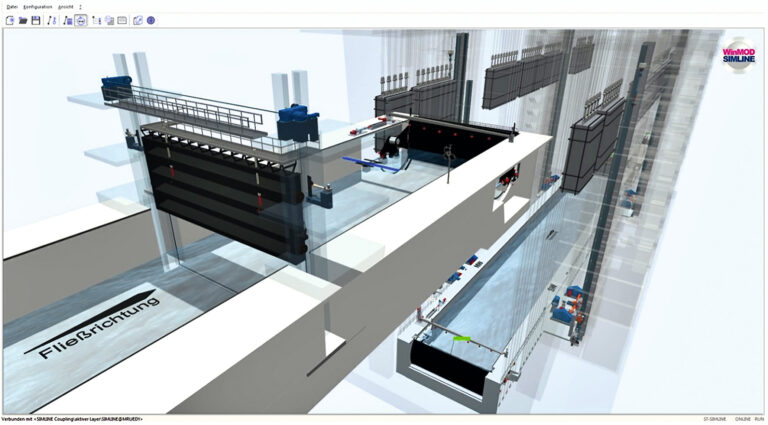
In order to rule out these immense risks to the Niederfinow ship lift from the outset, the WNA Berlin commissioned the creation of a fully functional digital twin (plant simulation model) for virtual commissioning.
The WinMOD plant simulation system replaced the actual system to be controlled with a virtualised system featuring real-time behavioural simulation. The simulation covered the entire drive and sensor level, providing a comprehensive representation of the electrical, mechanical and hydraulic behaviour of the actuators and sensors. This model was connected via simulated PROFIBUS and PROFINET networks. A detailed three-dimensional visualisation of signals, responses and time histories made the behaviour of the entire plant significantly more transparent and comprehensible to the engineers.
The entire software suite – that is, the programmes developed for the programmable logic controllers, the operator panels and the process control system – was thus thoroughly tested in advance, long before the installation of the plant components (control cabinets) at the Niederfinow ship lift took place. WinMOD made it possible to identify unforeseen errors at an early stage, to map out all operating modes in detail and to safely simulate the consequences of operating errors as well as every conceivable fault scenario.
Expert opinion from the project
„Virtual commissioning is a highly effective tool for software quality assurance, both during the construction and commissioning phases of the new Niederfinow ship lift. Virtual commissioning eliminates the increased risk of operating errors and procedural faults.“
Frank Ulrich, Graduate Engineer
Former Head of Department at the Berlin Waterways Construction Authority
CONCLUSION
Sustainable success for the Niederfinow ship lift thanks to WinMOD
- Abbreviated acceptance procedures: The successful software testing on the simulation model was a prerequisite for approval to proceed with testing at the plant; thanks to the outstanding quality of the software, this led to significantly shorter plant acceptance and commissioning times for the individual plant components.
- Risk-free training courses: As the digital twin is fully operational and runs in parallel with the Niederfinow ship lift, the operating staff were able to undergo intensive training in advance, entirely free of risk.
- A future-proof system: The digital twin will continue to be available to operating and maintenance staff for regular drills and to help them prepare for the practical operation of the plant.
- Basis for updates: Should any software modifications be required due to technical adjustments or changes to parameters, the WinMOD-based software testing system remains a tried-and-tested foundation that can be used on a long-term basis.
Frequently Asked Questions (FAQ) about the Niederfinow Boat Lift
What is the new Niederfinow ship lift?
This is a replacement structure for the historic lift, which was built by the Federal Waterways and Shipping Administration (WSV) at a cost of around 300 million euros. It ensures the reliable continued operation of the waterway and enables the passage of significantly larger vessels with dimensions of up to 110 metres in length, 11.45 metres in width and 2.80 metres draught.
What is the difference between a ship lift and a lock?
A lock overcomes differences in height by filling or emptying a fixed chamber with water, causing the vessel to rise or sink. A ship lift, on the other hand, is a lift for ships: it mechanically transports the vessel, together with the water, up or down in a huge movable trough. Lift systems are usually used where there are significant differences in elevation, as they can overcome these much more quickly and with far less water consumption than conventional lock systems.
How does the ship lift at Niederfinow work?
The new structure is designed to function as a vertical lift with a counterweight system. The water-filled trough is mechanically driven. This drive is provided by four pinions and rack-and-pinion guides fixed to the supporting framework. Four rotating bolts, which run within nut-jaw columns, are used to secure the trough. A mechanical and an electronic synchronisation system ensure that the four heavy-duty trough drives operate in perfect synchronisation.
Where is the Niederfinow ship lift located?
The ship lift is situated in the municipality of Niederfinow in Brandenburg, on the Oder-Havel Canal. As the central structure of the Havel–Oder waterway, it lies north-east of Berlin and represents one of the most important navigable links between the Havel and the Oder (and, further on, to Szczecin and the Baltic Sea).
How high is the new Niederfinow ship lift?
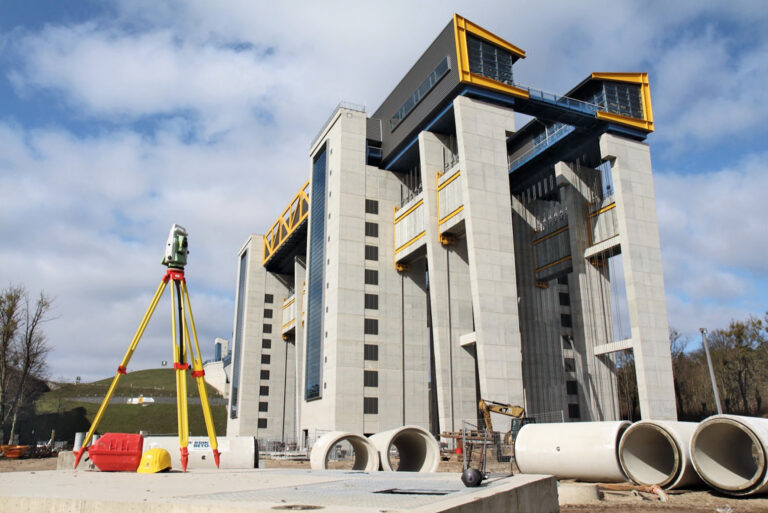
The structure must bridge an enormous difference in height of around 36 metres between the upper and lower levels of the canal. The total architectural height of the massive concrete pylons is approximately 55 metres. The clearance height for ships is 5.25 metres above the upper operating water level.
When was the new Niederfinow ship lift built?
The construction of this major project spanned more than a decade, with building works progressing steadily throughout the 2010s (a documented construction status as part of the virtual commissioning carried out alongside the building works dates from March 2019). Following extensive testing phases and the virtual validation of the plant control system, the new lifting station was officially opened for regular shipping traffic in October 2022.
Is the Niederfinow ship lift still in operation?
Yes. The old ship lift, situated right next to it, had been in operation since 1934. The construction of the new replacement facility will now ensure the reliable long-term operation of the waterway. However, the historic lift will remain in operation alongside it for the time being as a fascinating piece of engineering heritage.
Is it possible to visit the new ship lift in Niederfinow?
Yes, the Niederfinow ship lift is one of the most significant tourist attractions in Brandenburg. Visitors can admire the enormous scale of both structures and visit the associated information centre. In addition, local passenger boat trips offer the chance to experience the spectacular journey through the lift’s trough first-hand from the water.