Virtual commissioning
Tested automation software – to ensure your machines and systems start up on time.
Avoid lengthy commissioning times and costly downtime. Discover why Virtual Commissioning (VC) is now the most important milestone in modern process and factory automation.
- Individual problem analysis
- Presentation of the appropriate WinMOD solutions
- Tailored range of services
Challenges in industrial project management
Regardless of whether the actual plant components are installed and ready for operation on time or not, if complex automation systems are only tested during final on-site assembly, the entire schedule is thrown into disarray.
60 %: It has been demonstrated that all delays during commissioning are caused by undetected software and logic errors.
An incorrect parameter in the code not only leads to delays on site, but, in the worst-case scenario, to actual collisions and costly damage to tools or machinery.
Spending days on site troubleshooting results in high travel and accommodation costs, ties up valuable specialist staff and risks eating into the margin due to contractual penalties for late delivery.
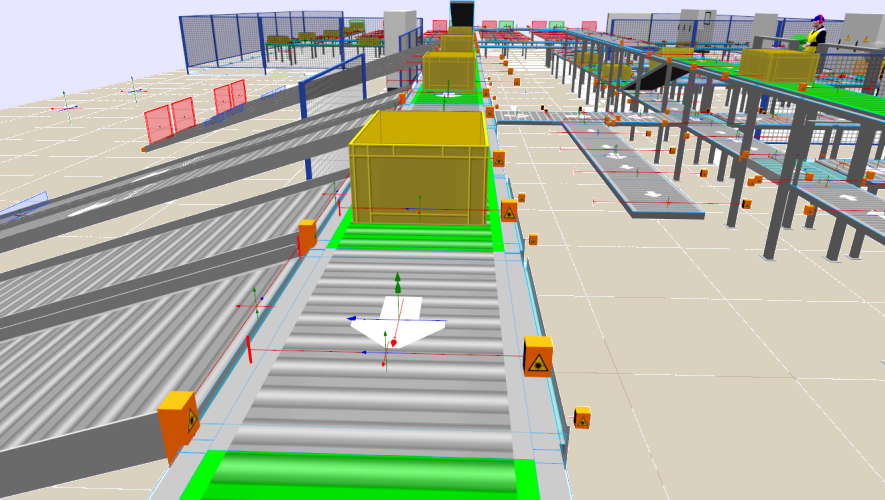
Virtual commissioning (VC) is the process by which the automation software of a machine or plant is comprehensively tested using a digital behavioural model – the functional digital twin.
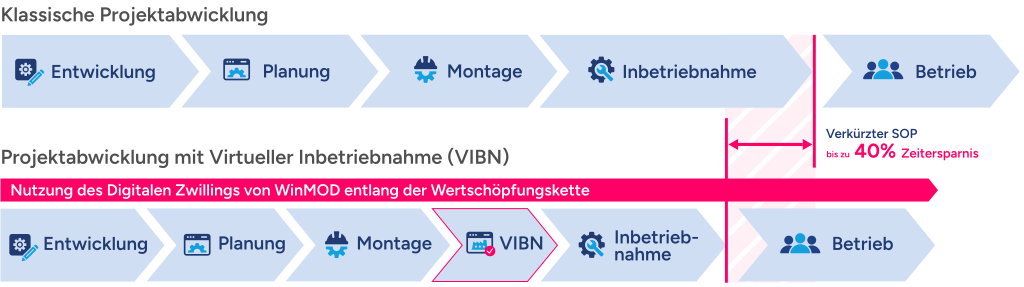
From sequential to parallel engineering
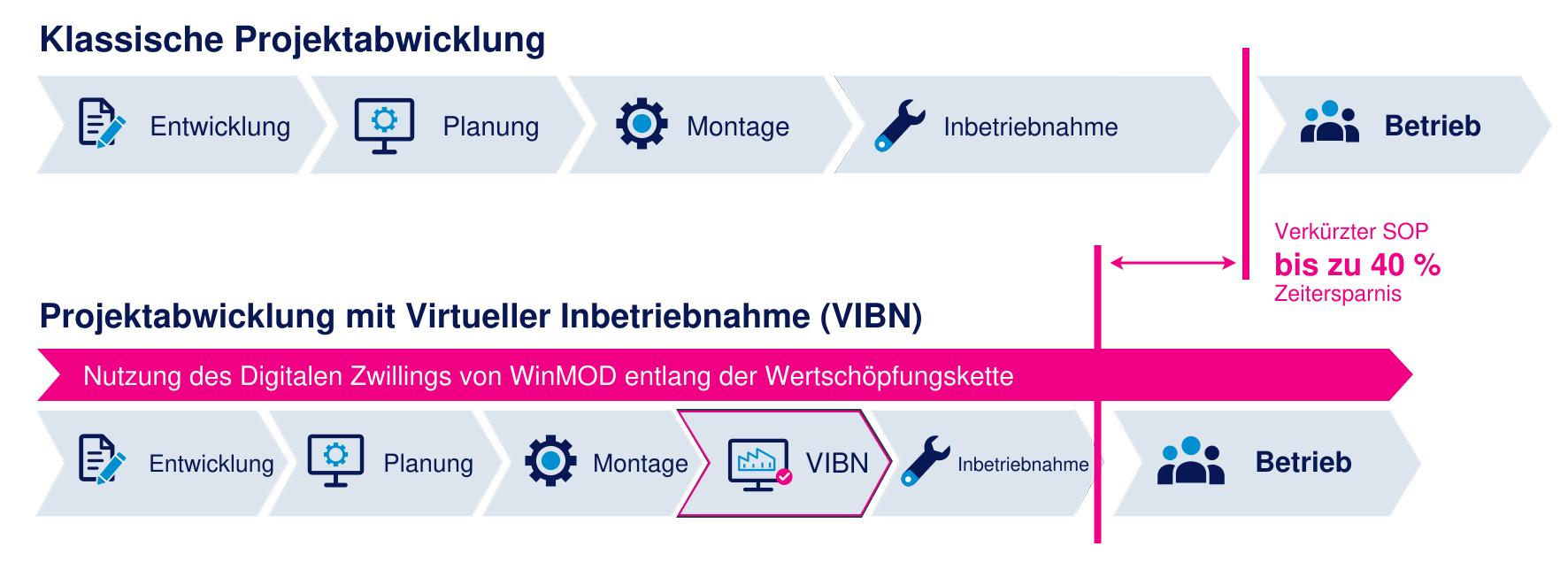
The benefits of WinMOD
The physical installation of the system and software testing are carried out in parallel. This reduces the project duration and allows for early adjustments to the planning.
Protection against damage caused by operational errors and the minimisation of energy and material resources.
Machinery and plant are supplied with tried-and-tested software. This minimises downtime and optimises day-to-day operations.
Iterative software development with concurrent software testing, right through to a fully operational application and final virtual commissioning in the office. Any remaining commissioning time and software adjustments required on real machines or plant are reduced to a minimum.
Risk-free training for operators, service and commissioning staff using the digital twin.
Before, during and after actual commissioning, the digital twin enables further plant optimisation at any time.
Frequently Asked Questions
How much does a virtual commissioning cost?
It is not possible to give a flat-rate figure for the cost of a VC, as this depends heavily on the size and complexity of the simulation. The cost is essentially made up of two factors:
The WinMOD software system: Scales modularly depending on actual automation systems and the scope of technology.
The engineering effort: The time taken to develop the digital behavioural model.
The investment starts at relatively small amounts for individual stations, but in practice it usually pays for itself as soon as the first delay in commissioning on the building site is avoided.
How does a VC work?
Virtual commissioning takes place as part of a clearly defined three-step process:
- First, the physical plant is modelled digitally.
- The PLC is then connected to the control software so that the plant processes can be simulated and tested virtually.
- Errors and areas for optimisation are identified and rectified at an early stage, before the control system is deployed on the actual plant.
What is the economic justification for VC?
The economic justification (the ROI) for virtual commissioning is best explained by the principle of radical risk minimisation. Any error that is only noticed once work has begun on the customer’s actual construction site costs many times more than it would have cost to rectify it in the office. In practice, the investment in a WinMOD licence and the time spent building the model often pay for themselves simply by preventing the very first system crash.
When considering cost-effectiveness from a holistic perspective, the benefits are not limited solely to the reduction in travel and accommodation costs. Here is a detailed breakdown of the risks that are effectively mitigated by WinMOD:
| Risk factor | The real problem on the building site | The cost-effective solution through virtual commissioning (e.g. using WinMOD) |
| Test risks (hardware) | PLC code that has not been adequately tested on actual machines poses a serious fire hazard. Faulty control logic can, for example, lead to unexpected movements, causing parts of the system or workpieces to collide with one another and result in damage. | Free collisions: Nothing breaks in the digital twin. You can test critical limit conditions and emergency stop sequences in a completely non-destructive manner, as often as you like. |
| Human risks | Commissioning engineers often work on site under extreme time pressure, whilst suffering from jet lag or construction site noise. Fatigue inevitably leads to a higher error rate. Furthermore, working alongside machines weighing several tonnes that have not yet been tested poses an enormous physical safety risk to staff. | Stress-free engineering: The most critical and error-prone part of the work – debugging the code – is moved to a quiet, safe and ergonomically designed office environment. This protects staff health and helps retain skilled workers. |
| Hidden sources of error | Modern systems consist of tens of thousands of I/O signals. A simple transposition in the sensor configuration within the E-CAD software may go unnoticed mechanically, but leads to a system crash in the software. On site, the nerve-wracking search for a needle in a haystack then begins. | Maximum transparency: WinMOD visualises signals and logic in real time. Signal errors are immediately apparent thanks to the 3D simulation and can be rectified with just a few clicks, before the first actual cable is laid. |
| Financial risks | Delays in delivery can prove extremely costly in plant engineering. In the event of delays, contractual penalties can very quickly eat into the entire project margin. Actual commissioning often acts as a bottleneck, as it can only take place at the end of the project chain. | Reliability of delivery: Through Concurrent Engineering Programmers no longer have to wait until the mechanical components have been fully assembled. The software is tested in parallel, which drastically reduces lead times and ensures the delivery date is met. |
In summary: From a financial point of view, virtual commissioning is not merely „simulation software“, but the most effective insurance policy against contractual penalties, hardware damage and staff burnout that a plant manufacturer can take out today.
Why virtual commissioning? / What are the benefits of virtual commissioning?
Virtual commissioning offers a Time saved from to to 75 % during actual commissioning on site. The key benefits of using WinMOD include:
- Early Error detection:Software bugs are now being identified and rectified in a relaxed atmosphere in the office, rather than under time pressure on the building site.
- Solid Cost reduction:They help you avoid unexpected delays for customers, save on expensive travel costs for last-minute call-outs and eliminate the risk of hardware damage caused by collisions.
- Higher Software quality:By enabling the straightforward simulation of fault scenarios, the control code achieves a level of maturity that could not possibly be tested on real machines for safety reasons.
Get advice now and find out more about WinMOD. We’ll assess your specific requirements, give you an insight into the software and answer your questions – free of charge and with no obligation.